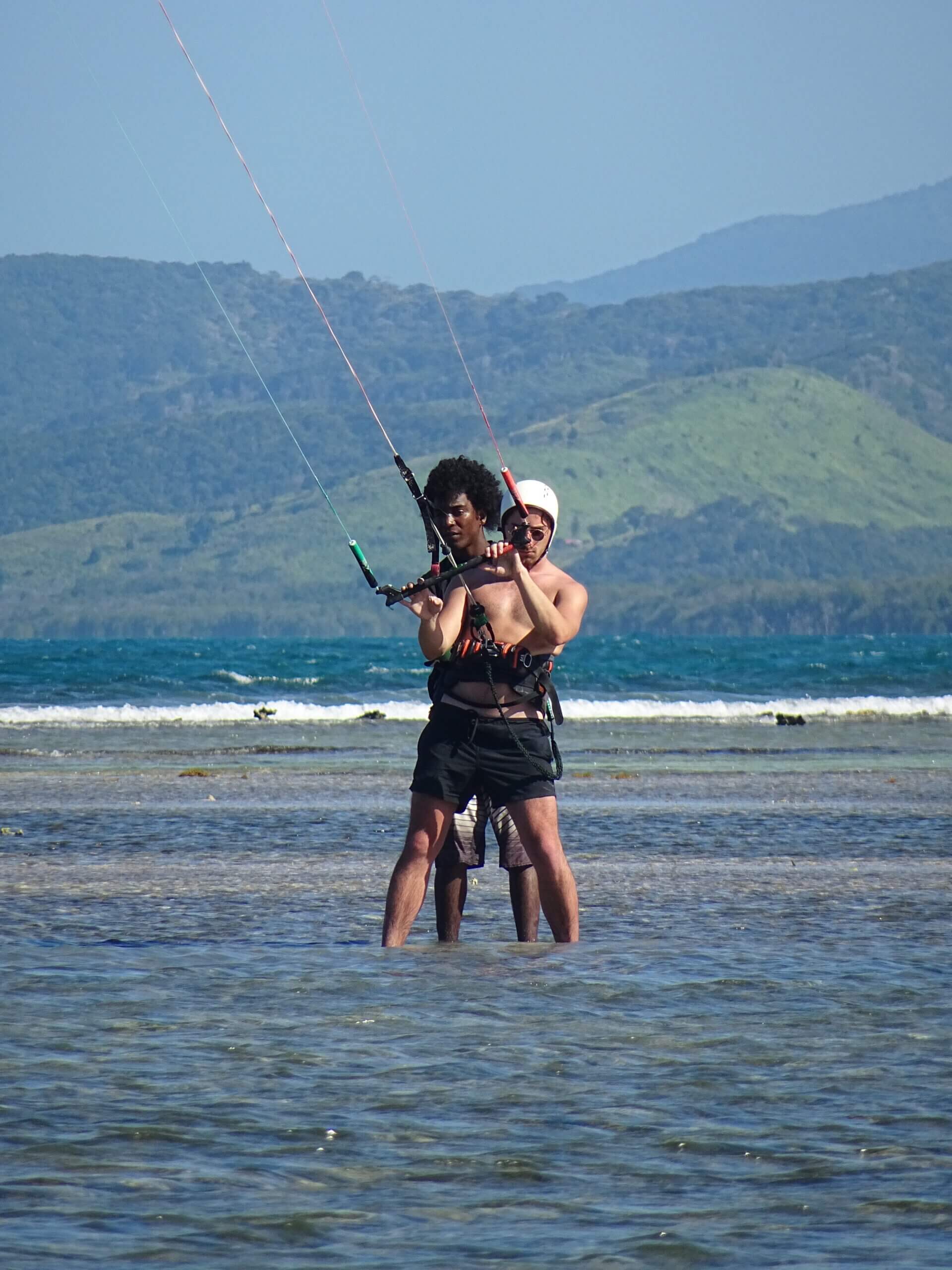
Your first kiteboarding lesson will not involve a board. You will spend the session on land and in shallow water, learning to fly the kite and drag through the water under kite power. By the end of a three-hour session, most students can body drag in both directions and feel the power window in their hands. That is real, tangible progress.
Here is exactly what happens.
Session 1: Ground School and First Flights (Hours 1 to 3)
On the beach:
Before you go near the water, your instructor runs through kite theory. Wind windows, safety release systems, what to do if the kite gets away from you. This is not optional classroom time. Understanding the theory before you touch the kite means you make better decisions in the water.
You will then set up a trainer kite or a full-size lesson kite under supervision and learn to steer it from the beach. The power zone, the neutral zone, how to park the kite safely.
In the water:
Once you are comfortable flying the kite on land, you move into the water. The goal of the first session is body dragging: letting the kite pull you through the water without a board. You learn directional control, how to stop yourself, how to recover the kite from the water. It sounds simple. It is also the foundation for everything that follows.
Session 2: Body Dragging with a Board (Hours 3 to 6)
In the second block of sessions you learn to drag with a board attached to your feet. The board is not under you yet. You are practising board recovery – picking up your board from the water while controlling the kite with one hand. It takes more coordination than it sounds.
Your instructor is in the water with you or watching from shore using a radio helmet, giving real-time feedback on your kite position. This is where most students start to feel confident. The kite becomes more intuitive and less of a thing you are fighting.
Session 3: Water Starts (Hours 6 to 9)
This is where it comes together. You get the board under your feet, generate power in the kite, and try to stand up and ride. Your first few attempts will probably end with you falling. That is expected and completely normal.
The water start is the hardest technical skill in the beginner course. Most students need several sessions to get it consistently. When it clicks, it is immediately obvious.
By the end of 9 hours, the goal is independent riding: upwind riding in both directions and the confidence to handle your own launches and landings. That is the IKO Level 1 sign-off.
What Should You Bring?
- Swimsuit
- Sunscreen (waterproof, apply before you get in the water)
- Water bottle
- A rashguard if you burn easily
KiteDR provides the kite, board, harness, helmet, and impact vest. Nothing else is required.
How Physically Demanding Is It?
More than most people expect in the early sessions, less than people expect by the end. Body dragging works your core and shoulders. Water starts are the most physically demanding part. By the time you are riding, the kite does most of the work and the effort drops significantly.
You do not need to be an athlete. A reasonable level of fitness and comfort in open water is all that is required. Most people in ordinary health complete the course without physical difficulty.
What If the Wind Is Not Right on My Session Day?
KiteDR monitors conditions daily. If wind is insufficient or too strong for your level, the session is rescheduled at no extra charge. Cabarete’s trade winds are among the most reliable in the Caribbean, particularly from December through August, so multi-day delays are uncommon. Your instructor will also make calls within a session – if conditions shift mid-lesson, you adapt.
For a full breakdown of what the wind does in Cabarete through the year and which months are best for learning, see the kitesurfing guide to Cabarete, Dominican Republic.
How Long Until I Am Riding Independently?
Most students reach independent riding level after 9 hours spread over 3 to 4 days. Some get there sooner. A small number need a few extra hours. The IKO curriculum is structured to give each skill time to consolidate before the next is introduced, which is why spreading it across multiple days produces better results than cramming it into one.
Frequently Asked Questions
Do I need any experience before my first lesson?
No. The beginner course starts from zero. No kite experience, no board sports background needed.
Can I watch other students before my lesson?
Yes. Kite Beach is a public beach. Watching experienced riders before your session is a good way to calibrate expectations.
How many students will be in my session?
KiteDR limits groups to two students per instructor. Most students choose private lessons (one-on-one) for faster progression.
Will I be in the sea immediately?
Not in the first hour. You start on land, move into shallow water, and progress from there. You will not be in open water until your kite skills are solid enough to handle it safely.
Is it safe as a complete beginner?
Yes. The IKO curriculum introduces risk in stages. You do not attempt the next skill until the current one is solid. All students wear a helmet and impact vest. Kite Beach has consistent side-shore wind, shallow water in the teaching zone, and no close-in obstacles.
Want to know what the full course will cost before you book? The kiteboarding lesson pricing guide covers private and group rates, what’s included, and a realistic Cabarete trip budget.
Book your first lesson or ask us anything on WhatsApp.